Keep the evidence behind the observation.
A planned workflow connecting site captures, model references and issue history so observations can be revisited.
The information.
The context. The next step.
An observation becomes difficult to review when its photograph, location and design reference are separated. The intended evidence workflow keeps those sources connected as an issue moves towards a decision.
 Ground TruthIllustrative workflow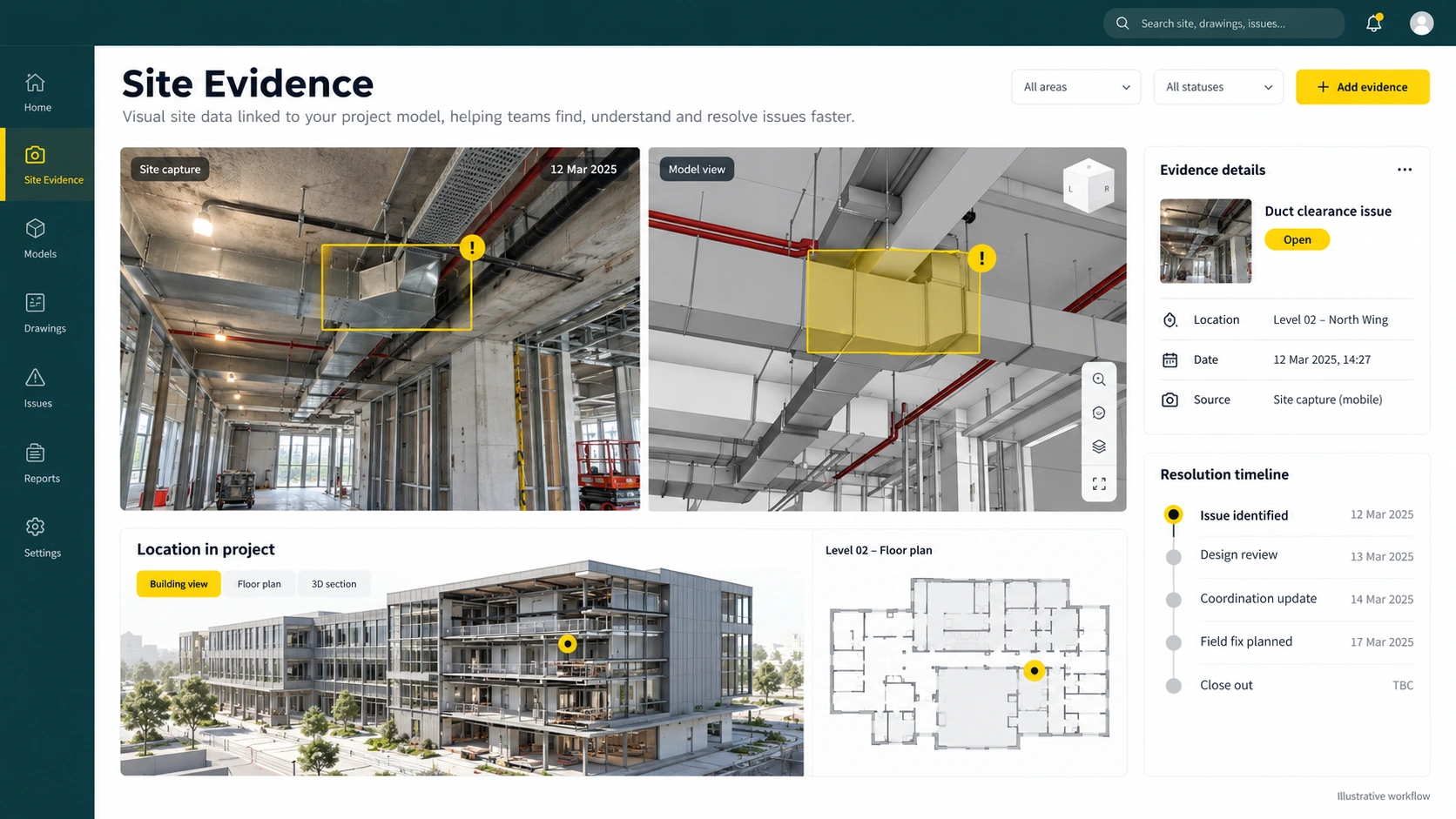
From source information to a useful action.
- 01
Capture evidence
Keep the location and observation date.
- 02
Link context
Associate the relevant model and issue.
- 03
Review resolution
Follow the evidence through the decision.
A services installation is questioned during a progress meeting.
The proposed evidence record brings the dated capture, model reference and engineer’s description together. A later reviewer can revisit those sources without reconstructing the context from messages.
Capabilities and delivery scope.
Ground Truth’s wider evidence, status and resolution-history workflows are planned. Current capture, comparison and issue-reporting scope is confirmed separately in your demonstration.
- Location-based evidence foundation
Identify the building, level and room so another reviewer can locate the work.
- Dated captures and BIM comparison
Retain the capture and design references that support the review.
- Engineer issue reporting
Separate what is visibly observed from an interpretation or proposed action.
- Planned evidence-linked observations
Associate the observation with its supporting information.
- Planned status and resolution history
Follow responses and verification steps alongside the original evidence.
- Planned user and decision traceability
Make the responsible reviewer and decision context understandable.
A clearer starting point.
Does Ground Truth mean automatic verification?
No. A photograph records visible conditions. Engineering interpretation and verification must remain explicit.
What makes evidence useful?
A clear location, date, source reference and description let another person review the observation without guessing its context.
Bring one project question. Leave with a clearer scope.
Walk through the relevant workflow, source information and rollout requirements with the BIMerge team.